

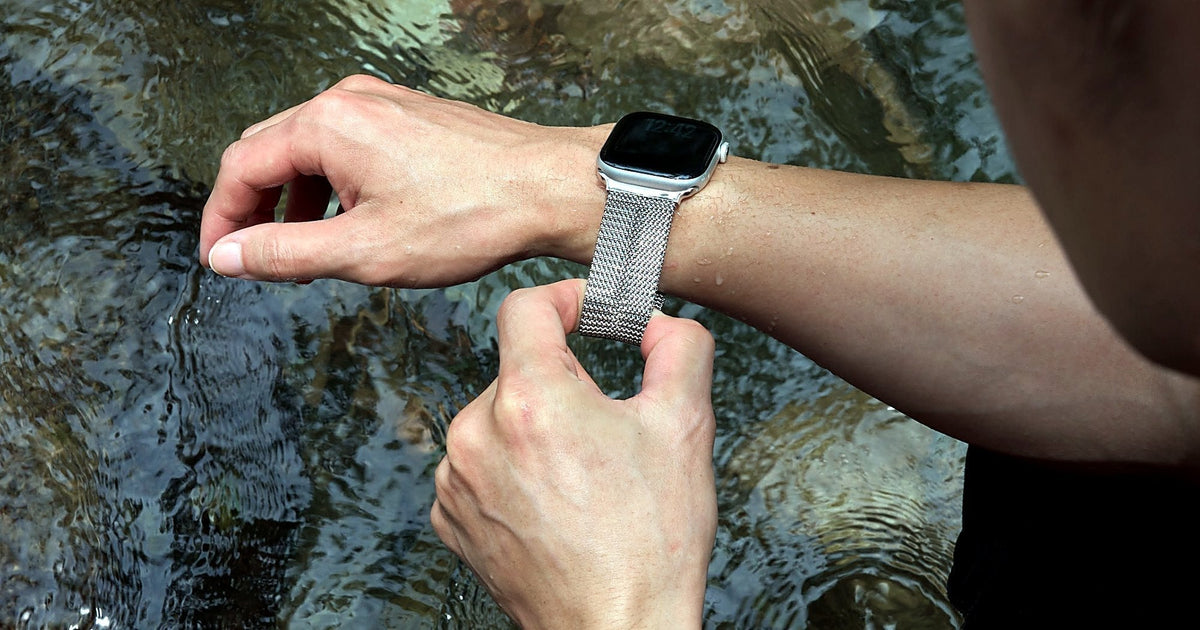
There are only two honest ways to make a watch band fit. Size it exactly to your wrist and skip the hardware, or build in hardware that lets you adjust it. Stretch-fit does the first. Adjustable does the second. Both work, and they fail in completely different ways.
Eclipex builds one of each, so this comparison is also a straight answer to the question we get most: One Flex or Flex Link. Here is how the two fits differ in practice, and which wrist each one suits.
Stretch-Fit vs. Adjustable: The Quick Guide
What Stretch-Fit Actually Means

A stretch-fit band has no buckle, no clasp, and no links to remove. It is a closed loop, cut to one wrist size, that stretches over your hand and settles back to shape.
On One Flex the stretch comes from the weave itself. The band is woven 316L stainless steel, engineered so the structure gives rather than the material tiring out. That is the difference between this and a fabric solo loop, which stretches because its threads are under tension and slowly stops recovering.
The tradeoff is honest: sizing happens before you buy. Get it right and the band disappears on your wrist. Get it wrong and there is no clasp to rescue you, which is why the size scale matters so much on this style.
What Adjustable Fit Actually Means
Flex Link works the other way around. Polished alloy links sit over an elastic core, and an adjustable clasp sets the base length. The clasp gets you close, the elastic handles the rest, so the band flexes as your wrist changes through the day rather than sitting at one fixed circumference.
You size it after it arrives instead of before. That makes it the safer choice when you are buying without measuring, when a wrist sits between two sizes, or when more than one person in a household might wear it.
Stretch-Fit vs. Adjustable: Getting It On and Off
Stretch-fit wins on speed and it is not close. One motion, no hands fumbling behind a wrist, nothing to fasten. If you take your watch off and put it back on several times a day, that adds up.
Adjustable wins on control. Opening a clasp means you can loosen the band without removing it, tighten it before a workout, and put it on with one hand once you learn the motion. Some people simply prefer the ritual of a clasp, which is a real preference rather than a technical one.
The adjustment method depends on the band design. If you're unsure where to start, our guide on adjusting a metal watch band explains the different methods for clasps, removable links, and mesh bands.
Verdict: stretch-fit for speed, adjustable for control.
Stretch-Fit vs. Adjustable: Sizing and Accuracy
One Flex uses sizes 3 to 11 on the same numbered scale Apple uses for its own Solo Loop, so if you know your Apple size you already know your One Flex size. Small covers 40, 41 and 42mm cases, large covers 44, 45, 46 and 49mm, and both fit Apple Watch Ultra 1 to 3, Series 4 to 11 and SE.
That numbered range is the whole argument for stretch-fit. A band cut to your wrist applies even pressure the whole way around, which keeps the sensor flat against your skin and your heart rate data honest. Bands sold as small, medium and large cannot promise that, because a bracket is not a size.
Flex Link asks nothing of you upfront. Order it, put it on, set the clasp. If you have never measured your wrist and do not intend to, that is a real advantage.
Verdict: stretch-fit is more precise, adjustable is more forgiving.
Know your Apple Solo Loop size? You already know your One Flex size.
Stretch-Fit vs. Adjustable: Comfort Over Sixteen Hours

Comfort problems in watch bands almost always start at a pressure point, and pressure points come from hardware. A clasp concentrates weight in one place on the underside of the wrist. It is fine for a working day and it is the reason people take clasped bands off before sleeping.
A stretch-fit loop has no such point. Pressure spreads around the full circumference, which is why this style dominates among people who track sleep or wear a watch sixteen hours a day.
Where adjustable pulls ahead is heat and swelling. Wrists change size through a long flight, a hot day or a hard session, and a clasp lets you respond. With stretch-fit you rely on the weave to absorb that, which it does within reason.
Verdict: stretch-fit for long unbroken wear, adjustable when your wrist changes a lot during the day.
Stretch-Fit vs. Adjustable: How Each One Reads

These two look different enough that plenty of people choose on appearance alone, and that is a legitimate way to decide.
One Flex reads as a woven mesh band. Fluid, close to the wrist, closer to fabric than to jewelry in the way it moves, with the presence of metal because it is metal.
Flex Link reads as a classic link bracelet. Defined links, polished faces, a visible clasp. It is the more traditional watch look of the two, with give built in where a normal bracelet has none.
Verdict: a tie, decided by which one you want to see on your wrist.
Which One Should You Buy?
Buy stretch-fit if you know your size or own an Apple Solo Loop, you wear the watch all day and overnight, you train in it, or you want the band on and off in one motion.
Buy adjustable if you have never measured your wrist, you sit between two sizes, you want the classic bracelet look, or the watch is a gift and you cannot ask the recipient their size.
Both are built on the same idea. A band should adapt to your wrist instead of asking your wrist to tolerate the band. They just get there by different routes. More answers on sizing, fit and compatibility are on our FAQ page.
Stretch-Fit and Adjustable Band FAQs
Is a stretch band better than an adjustable one?
Neither is better across the board. Stretch-fit is more precise and more comfortable for long unbroken wear. Adjustable is more forgiving, easier to buy without measuring, and easier to loosen mid-day.
What size stretch band should I order?
Your Apple Solo Loop size, if you have one, since One Flex runs 3 to 11 on the same scale. If you do not, measure your wrist before ordering, or choose the adjustable band instead and set the fit at home.
Do stretch metal bands lose their shape?
Fabric ones do, because their threads sit under tension and lose recovery over months. When the stretch comes from a woven metal structure, the band holds its shape far longer, since nothing is being pulled past its limit to make room for your hand.
Can I wear either style to the gym?
Yes. Metal absorbs no sweat and holds no odor, unlike fabric. Rinse and dry the band afterward and it is ready for the office. For swimming or heavy lifting where the band takes knocks, a silicone sport band is still the sensible spare.
Which watches do they fit?
Both cover Apple Watch Ultra 1 to 3, Series 4 to 11 and SE. Pick the small fitting for 40, 41 and 42mm cases and the large fitting for 44, 45, 46 and 49mm.
The Bottom Line
Stretch-fit removes the hardware and asks you to know your size. Adjustable keeps the hardware and asks nothing in advance. That single trade is the entire decision.
If you know your number, take the band with nothing on it. If you would rather sort the fit once it is on your wrist, take the clasp.
One Less. One Flex.
The Next-Gen Milanese Solo Loop
Shop One FlexShare:
The Best Apple Watch Bands in 2026: A Complete Buying Guide
Apple Watch Band Compatibility: Every Model and Case Size