

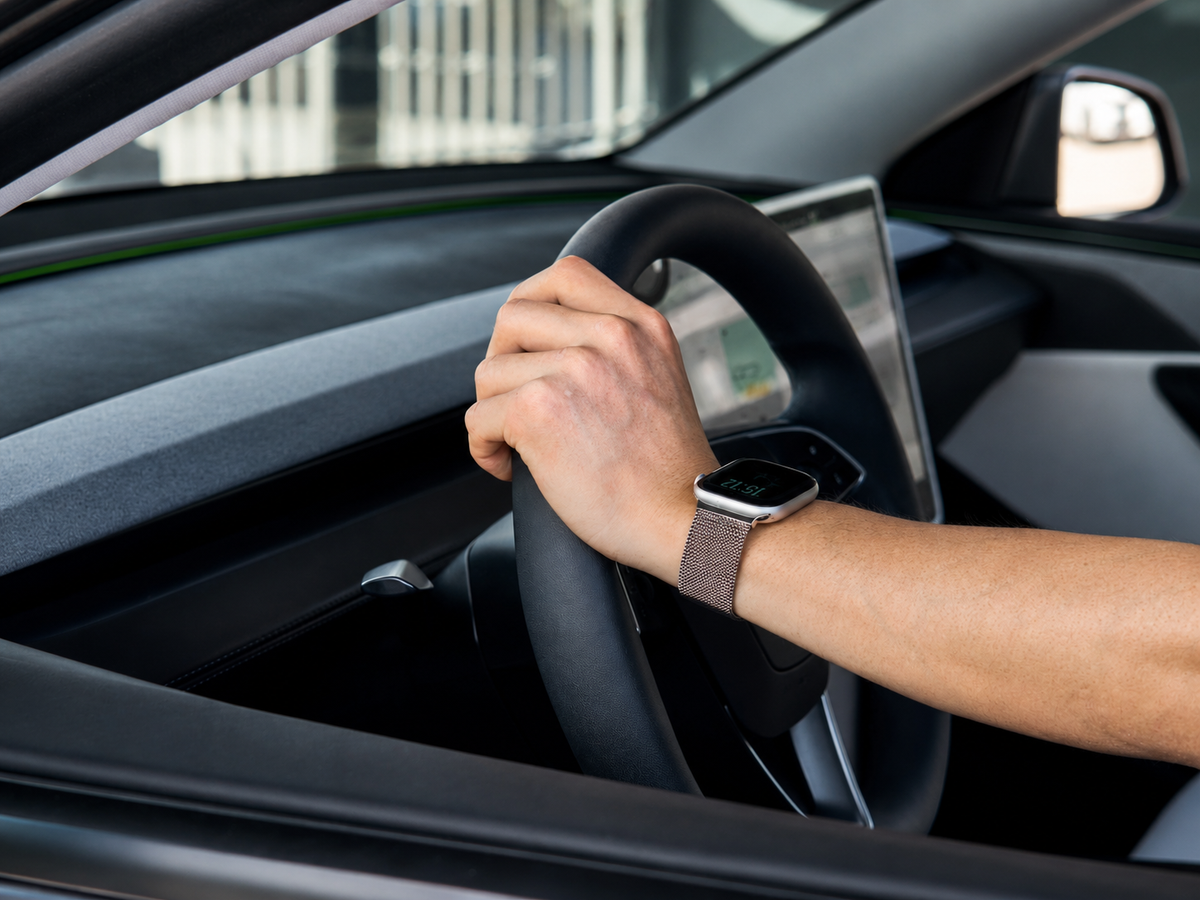
Ask which are the best Apple Watch bands and most answers describe a photograph. Your actual week is the better test: a meeting on Tuesday, a workout on Wednesday, a flight on Thursday, and you never once think about your wrist.
Four decisions get you there, in this order. Where you wear the watch. What the band is made of. How it fastens and fits. What to check before you pay. Work them in that order and the shortlist gets short fast.
The Best Apple Watch Bands at a Glance
| Band type | Best for | Skip it if |
|---|---|---|
| Solo loop (fabric) | All-day and overnight comfort | You need it to look formal |
| Solo loop (woven steel) | One band for work, gym and travel | You want a clasp to adjust |
| Sport band (silicone) | Swimming and heavy lifting | You wear it to client meetings |
| Link bracelet | Formal presence, long life | You hate sizing tools |
| Milanese loop | Infinite adjustment, office wear | You wear tight shirt cuffs |
| Leather | Formal settings, dry climates | You train in your watch |
Start With Your Day, Not the Style
Sorting by looks is how people end up with three bands and a drawer to keep them in. The band that wins the photo rarely wins your Thursday.
So map the week honestly. If the watch goes desk to gym to airport without going home in between, you need one band that takes sweat and still reads right in a room full of people. If it comes off at six and never sees a treadmill, buy whatever you like the look of. That one question clears most of the catalog before you have looked at a single color.
Every Band Type in 60 Seconds
Solo loops have no clasp. They stretch over your hand and press evenly all the way around, which is why they win long days and sleep tracking. Fabric versions relax over months. Woven steel versions do not.
Sport bands are silicone, built for water and impact. They rinse clean in seconds and they look exactly like what they are.
Link bracelets are the formal end of metal: substantial, long-lived, sized by removing whole links. That means a tool and some patience.
Milanese loops are fine steel mesh with a magnetic closure that slides anywhere along the strap. Endlessly adjustable, a little bulky under a cuff.
Leather is the traditional dress option, formal in any room, and sweat is what kills it. Our breakdown of leather vs. metal vs. elastic goes through the tradeoffs properly.
The Best Apple Watch Bands for Work and Meetings

In an office, the band is a small signal that something was chosen on purpose. Everyone recognizes the silicone strap that came in the box, and it says nothing at all.
Metal does the most work here. Link bracelets and woven steel both read as considered, and finish matters more than shape, since black, bronze, champagne and silver each land differently under office lighting. Searches for luxury Apple Watch bands and designer Apple Watch bands surface a lot of listings that show you a photo and never name the metal. Read the material line before you look at the styling.
Leather still wins in traditional industries. If your workplace runs on suits, a dark leather strap is never wrong.
The Best Apple Watch Bands for Women
Nothing about band material changes by gender, but sizing does. Smaller wrists sit at the bottom of every scale, which is exactly where one-size and small-medium-large bands fail hardest. Look for a numbered range that goes low enough to fit properly, and favor a slimmer finish like champagne or silver if a link bracelet feels heavy on a narrow wrist.
The Best Apple Watch Bands for Working Out and Travel

Sweat decides this category. Fabric soaks it up and keeps the smell. Silicone repels it and seals it against your skin instead, which is what usually sits behind the irritation people blame on the watch.
Steel is the one that surprises people who file it under dress option. It absorbs nothing, so nothing lingers, and an open weave or mesh moves air across the skin rather than sealing it off. Same reason it is the easiest band to wear through six hours of dry cabin air.
Swim laps and you want silicone in the drawer. For everything else, the one-band answer is metal with give in it.
The Best Stretch Apple Watch Bands
Stretch used to mean fabric or the cheap expansion bracelets sold on marketplaces, the ones with exposed spring edges that pinch arm hair. Woven steel changed the category: the give comes from the weave rather than from threads under tension, so the band goes on like a silicone strap and still holds its shape a year later. If you want stretch without the stretch-out, that is the version to buy.
One band that covers the meeting, the workout and the flight.
Apple Watch Band Material: What Actually Lasts
Apple Watch band material decides whether you buy once or buy every year. Leather cracks. Fabric loses its recovery. Plated metal wears through at the edges, usually right where the band meets the case.
316L stainless steel is the exception, and it is the grade used in marine fittings and surgical tools. Sweat and chlorides do not corrode it, which leaves scratches as the only real failure mode. Care splits the same way: steel wants a wipe, leather wants a routine. Our watch band care guide has the per-material detail.
The math behind that is the whole reason Eclipex builds this way. A band that lasts is a band you do not replace, which means less spending and less waste without anyone having to make a speech about it.
Getting the Size Right
Two numbers matter. Case size matches your watch, with 40, 41 and 42mm taking the small fitting and 44, 45, 46 and 49mm taking the large. Wrist size decides the rest.
Clasped bands adjust by holes or links, so they land close enough. Solo loops have to be exact, and this is where most disappointment happens. Apple sizes its own Solo Loop on a numbered 1 to 11 scale while most marketplace stretch bands sell small, medium and large. A bracket is not a size. Too loose and the watch slides down your wrist and hands you bad heart rate data. Too tight and it marks your skin by lunch.
Our solo loop sizing guide has the full chart in millimeters and inches, plus a two-minute way to measure your wrist without a tape.
What to Check Before You Buy
Start with the material name. "316L stainless steel" is a specification you can look up. "Stainless steel style" and "premium alloy" are not, and a listing that will not name its metal is telling you something.
Then check how the seller handles sizing. A numbered range built on Apple's own scale means somebody measured something. Small, medium and large means somebody guessed and left the rest to you.
Last, look at the connector. The lug is the part that fails on cheap bands, and a failed lug is how watches hit the floor. Fit it, listen for the click, then check it again every few months.
How Eclipex Fits In

One Flex was built for the person described at the top of this page: one watch, three contexts, no patience for swapping bands. It is a solo loop in 316L stainless steel, woven so the metal itself stretches. No buckle, no clasp, no links to remove, on in about a second.
Sizes run 3 to 11 on the same scale Apple uses for its own Solo Loop, so an Apple size carries straight over. Small fits 40, 41 and 42mm cases and large fits 44, 45, 46 and 49mm, covering Apple Watch Ultra 1 to 3, Series 4 to 11 and SE.
Everything about it is built for the same outcome: a band you buy once and stop thinking about.
Apple Watch Band FAQs
What are the best Apple Watch bands?
For daily wear across work and training, a woven steel solo loop covers the most ground: no clasp, no odor, no fabric to stretch out. Silicone is better for swimming, and leather is better for formal settings where the watch comes off at night.
What is the best Apple Watch band material?
316L stainless steel, for anyone who wears the watch daily. It resists sweat and corrosion, holds no smell, and outlasts leather and fabric by years with almost no maintenance.
Who makes the best Apple Watch bands?
Judge the maker by what they publish rather than by the name. A brand that names the exact alloy, offers real numbered sizes and shows the connector is telling you how the band was built. A brand that shows only styled photos is telling you something too.
Are all Apple Watch bands the same size?
No. Bands are grouped by case size, one fitting for 40, 41 and 42mm and another for 44, 45, 46 and 49mm. Within that, solo loops also need a wrist size, which is why the numbered scale matters.
What is the best Apple Watch band for work?
Metal, unless your industry expects leather. A woven steel or link band reads as deliberate in a meeting and needs no swapping before the gym afterward.
Are expensive Apple Watch bands worth it?
The cost that matters is cost per year of wear, and material decides that far more than branding does. A band built from a named alloy outlives several cheap ones, so the specification is worth more than the styling.
The Bottom Line
Your week decides the best Apple Watch bands for you, not a product photo. Sort by where you wear it, then by material, then by fit, and the answer is usually obvious by the second step.
Buy the one you can wear everywhere, and you get the real prize: a band you never think about again.
One Less. One Flex.
The Next-Gen Milanese Solo Loop
Shop One FlexShare:
How to Clean Your Apple Watch Band (and Make It Last)
Stretch-Fit vs. Adjustable Apple Watch Bands: Which Fits You?