

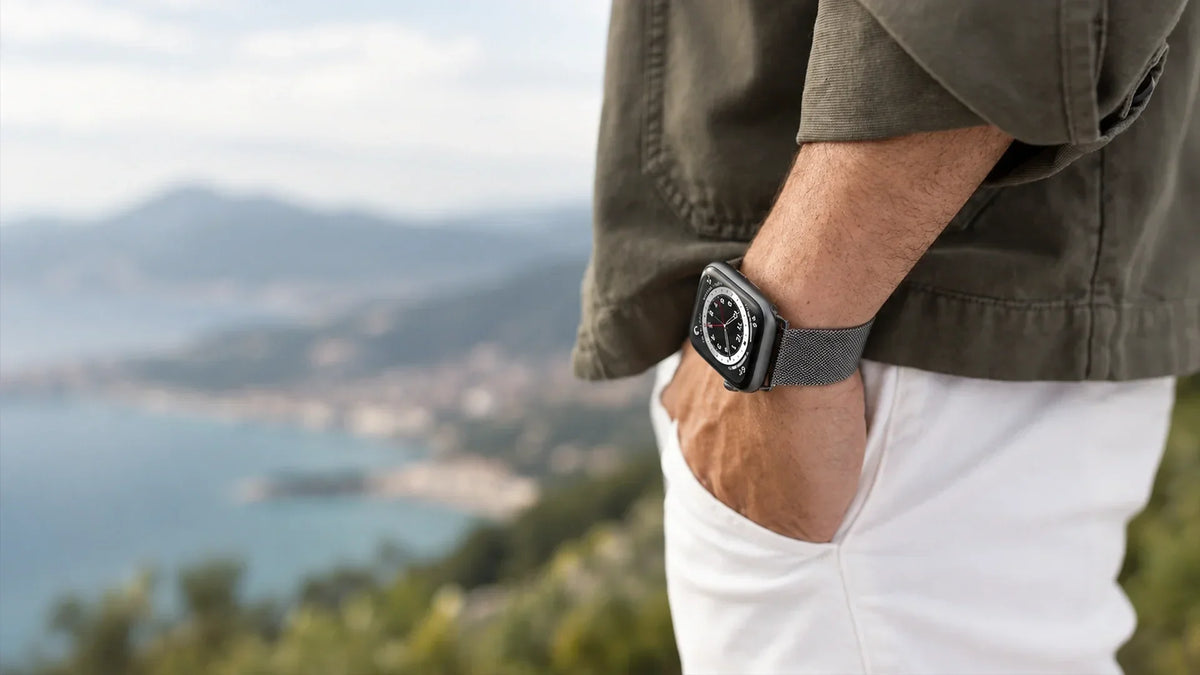
Apple's stainless steel Milanese Loop can be worth $99 if you plan to wear it regularly, want precise on-wrist adjustment, and specifically prefer Apple's design. It makes less sense for occasional use or if you're shopping on a tighter budget. And if you swim regularly, plan on switching to another band first.
This article focuses on Apple's stainless steel Milanese Loop with a magnetic closure, not the separate Titanium Milanese Loop. To help you make an informed choice, we’ve analyzed Apple’s official technical specs alongside long-term user reports to break down how the $99 band actually performs in daily wear—beyond the marketing hype. Eclipex sells Apple Watch bands and is not affiliated with Apple.
What Does Apple's $99 Milanese Loop Actually Buy You?
The reference model here is the 46mm Natural Milanese Loop in S/M, part number MJNR4AM/A. Apple's US store listed it at $99 when checked on September 12, 2026. The product page confirms several key construction details.
| Confirmed detail | What it means for the buyer |
|---|---|
| Woven stainless steel mesh | A flexible metal weave instead of a rigid link bracelet. |
| Magnetic closure | Lets you fine-tune the fit without relying on fixed buckle holes. |
| Physical vapor deposition (PVD) layer | Creates the finish used on this Natural model. |
That adjustability is useful when fixed sizing leaves you stuck between slightly too tight and slightly too loose. It's one of the main reasons people like the Milanese format. But adjustability alone doesn't explain why you should choose Apple's version over another magnetic mesh band.

There are still valid reasons to buy the original. You may prefer Apple's design, want a first-party band, or expect to wear it often enough to justify the $99 price. Those are reasonable reasons to spend more without assuming Apple's version automatically outperforms every alternative.
Price alone does not prove better comfort or longer service life. Those claims would require a direct comparison between specific bands, not an assumption based on the Apple name.
And while the Milanese Loop is highly adjustable on the wrist, it is not one-size-fits-all. Wrist-size range and Apple Watch case compatibility still depend on the exact version you choose.
Which Trade-Offs Could Make It a Poor Buy?
Water Use Is a Documented Limitation
Apple lists the stainless steel Milanese Loop as not water resistant and advises against exposing stainless steel bands to liquids. The Apple Watch itself may be water resistant, but that does not override the care guidance for the band.
If you swim before work and want to keep the same band on for the rest of the day, that alone may be enough reason to choose another option. Rinsing the band afterward does not change Apple's guidance. This is a limitation for water use, not evidence that the band performs poorly in other situations.
The separate Titanium Milanese Loop is different. It uses a dual-button buckle, and Apple describes it as suitable for water activities. Those claims should not be applied to the magnetic stainless steel model covered in this article.

Comfort and Closure Reports Need Context
In a May 2015 review for 9to5Mac, Jordan Kahn reported occasional hair snagging and said he sometimes had to readjust the band during the day, especially during physical activity. Even so, he remained happy with the band overall after a couple of weeks of wear.
That review is useful, but it covered an earlier version of the Milanese Loop rather than the current model referenced here. It can point to things worth checking, but it does not tell us how often today's version catches hair or needs readjustment.
When reading reviews, pay attention to the exact model and how long the reviewer wore it before applying those observations to the band you're considering.
If you spend most of the day at a desk, try the band with your wrist resting naturally in a typing position. Check where the overlapping mesh and magnetic end sit, then move and bend your wrist to see whether the fit stays in place without feeling restrictive. These are simple fitting checks you can do yourself, not conclusions from our own wear testing. Beyond fit and comfort, if you're also concerned about potential case wear, learn how and when can a Milanese Loop scratch your Apple Watch.
What Changes When You Choose an Apple Milanese Loop Alternative?
Before choosing an Apple Milanese Loop alternative, decide what you actually want to change: the price or the way the band fastens. Those are two different comparisons.
If price is the main concern, compare specific magnetic mesh bands side by side. Look at the actual price, material, closure, wrist-size range, Apple Watch compatibility, and return policy for each model. A similar product photo does not mean two bands will perform the same, just as a lower price does not automatically mean lower quality.
If you want to avoid a magnetic closure altogether, you need a different construction. One Flex is one example. It costs $59.99 and uses a continuous loop woven from 316 stainless steel, with the stretch built into the weave rather than a clasp or magnet. It is offered in nine loop sizes.
That changes the trade-off. With no closure, there is nothing to fasten or tighten once the band is on your wrist. Instead, the fit depends on choosing the right loop size from the sizing guide on the product page. It is a different way of putting on and fitting the band, but it does not by itself prove better comfort or durability than Apple's Milanese Loop.
Prefer a metal loop without a magnetic closure? See how One Flex handles fit and sizing →
One Flex Milanese Solo Loop →
Keeping your current band is also a reasonable option. If it already fits well and works for how you use your watch, a new band should solve a specific problem or give you something you actually want. Liking the Milanese look is reason enough to shop, but it does not make Apple's version a necessary upgrade.
Should You Buy It, Try It First, or Skip It?
| Decision | When it makes sense |
|---|---|
| Buy it | You expect to wear it often, specifically prefer Apple's version, and are comfortable with the $99 price and its care limitations. |
| Try it first | Your main concern is how the mesh feels on your skin, whether it catches arm hair, or where the magnetic closure sits during your normal routine. |
| Skip it | You want to swim without changing bands, prefer a non-magnetic closure, or cannot justify the cost for occasional use. The swimming limitation is based on Apple's own care guidance. |
Before ordering, confirm the exact part number, Apple Watch case compatibility, wrist-size range, and current price. It is also worth checking the seller's return policy, including whether you can briefly try the band on and whether a return would cost you anything.
So, is the Milanese Loop worth it? It can be, especially if you expect to wear it regularly and specifically want Apple's version. The value is harder to justify if your main goal is simply to get the Milanese mesh look.
The better reason to buy it is that its specific design, fit system, and first-party appeal match what you want—not because a higher price automatically means better comfort or a longer service life.
One Less. One Flex.
The Next-Gen Milanese Solo Loop
Shop One FlexShare:
316 Stainless Steel Apple Watch Band: What 316 Actually Means
Metal vs Silicone Apple Watch Bands: Which Is Better for Everyday Wear?