

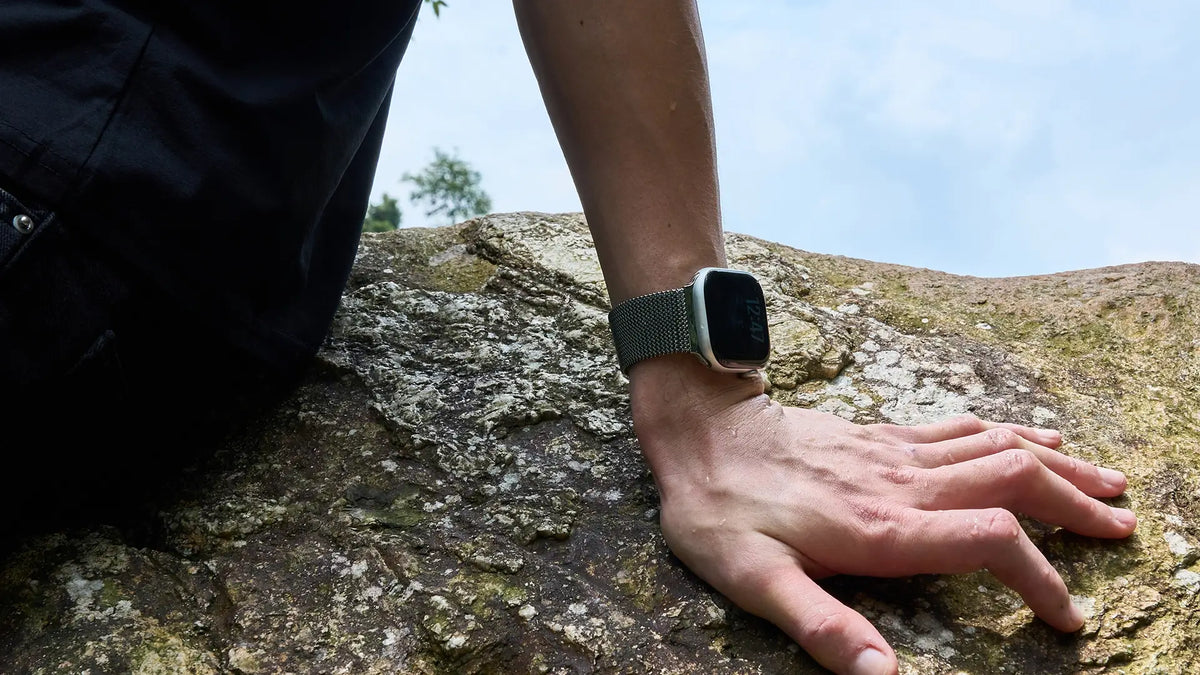
- Metal vs Silicone Apple Watch Bands at a Glance
- Material Is Only Half the Decision
- What Actually Changes Comfort Over a Full Day?
- Sweat, Water, and Cleaning: Follow the Band, Not Just the Material
- Durability and Value Depend on the Specific Build
- Which One Makes More Sense for Your Everyday Routine?
There is no automatic winner in a metal vs silicone Apple Watch band comparison. Silicone often makes sense for workouts and water, while metal tends to look more like a traditional watch or bracelet. But those labels only tell part of the story. A rigid link bracelet, flexible metal mesh, adjustable silicone strap, and continuous loop can feel completely different on the wrist. For everyday wear, the better choice comes down to the specific band: how it fits, how it moves, what it can handle, how much care it needs, and where you plan to wear it.

Metal vs Silicone Apple Watch Bands at a Glance
Start with the differences you will actually notice day to day. Then check the construction of the band you are considering, because material alone does not decide how it will wear.
| Everyday consideration | Metal bands | Silicone bands |
|---|---|---|
| Fit and adjustment | May use removable links, magnetic adjustment, a clasp, or a sized stretch loop | May use an adjustable closure or a fixed-size continuous loop |
| Feel on the wrist | Can range from rigid links to flexible woven mesh | Usually flexible, though fit and pressure still depend on the design |
| Workouts and sweat | Varies widely by construction and manufacturer guidance | Common in activity-focused designs, but not every silicone band has the same use limits |
| Water exposure | Metal alone does not tell you whether the band is meant for swimming | Some silicone bands are made for water use; check the specific product |
| Cleaning and care | Mesh, links, finishes, and closures can require different care | Often straightforward to wipe or rinse, depending on the design |
| Common style direction | Link and mesh designs often resemble traditional watch bracelets | Smooth straps and loops are common in sport-focused designs |
| Main trade-off | The metal look can come with very different levels of flexibility and adjustment | Flexibility is common, but sizing and closure systems still vary |
The point is not to count which side wins more rows. Material tells you what the band is made from. Construction tells you much more about what it will be like to wear.
Material Is Only Half the Decision
Two bands can share the same broad material and still behave very differently. Before comparing comfort, workouts, or durability, separate what the band is made from from how the band is built.

Metal Can Mean Links, Mesh, or a Stretching Weave
A traditional metal bracelet uses connected solid links and a separate closure. Depending on the design, getting the fit right may mean adjusting the clasp or adding and removing links.
Woven metal works differently. Apple's Milanese Loop uses stainless-steel mesh that wraps around the wrist, with a magnetic closure for adjustment. It is still a metal Apple Watch band, but it moves and fits differently from a rigid link bracelet.
Metal mesh can also be made into a continuous stretch loop. With no closure to adjust once it is on, fit depends more on choosing the right size and on how well the weave stretches and returns to shape.
So "metal bands are rigid" and "metal bands are adjustable" are both too broad. Either can be true. It depends on the band.
Silicone Can Use a Closure or Become the Closure
Silicone does not come with one fixed fit system either. It can be used in an adjustable strap, or it can form a continuous loop with no separate hardware.
Apple's Solo Loop takes the second approach. Apple describes it as a stretchable band made from liquid silicone rubber with no clasps, buckles, or overlapping parts. Instead of tightening it after you put it on, you choose a size and stretch the loop over your hand.
For a closer look at how these two fit systems differ, see our Milanese Loop vs Solo Loop comparison.
So "metal or silicone?" is only the first question. The next ones usually matter more: Is the band rigid or flexible? Can you adjust it on the wrist, or do you choose a fixed size? Does it use a closure, or is the band itself the loop?
What Actually Changes Comfort Over a Full Day?
Once you know how the band is built, comfort becomes easier to judge. Much of it comes down to how the watch stays in place while your wrist moves.
Fit and Adjustment
An Apple Watch band needs to hold the watch steady without squeezing your wrist. Apple recommends a fit that is snug but comfortable and notes that you may want to tighten the band for a workout, then loosen it afterward. The back of the watch also needs skin contact for several sensors and wrist-detection features.
That is where the fit system starts to matter.
An adjustable band lets you change the tension after it is already on your wrist. Magnetic mesh, a buckle-based strap, and an adjustable clasp all do that in different ways.
A sized continuous loop removes that step. There is nothing to tighten or loosen once it is on, so getting the size right matters more. Apple gives the same basic guidance for its Solo Loop: it should sit comfortably but snugly against the wrist.
Neither system is automatically more comfortable. An adjustable band gives you more control during the day. A continuous loop removes the closure, but asks more of the initial fit.
Pressure Points, Movement, and Hair Contact

Where the band touches your wrist matters too.
A clasp or buckle adds hardware at a specific point. A continuous loop removes that hardware. Solid links and woven mesh spread pressure and movement in different ways.
Hair pulling is just as dependent on construction. Gaps between links, the shape of the mesh, edge finishing, and moving hardware can all change how a metal band interacts with arm hair.
So if hair pulling is a concern, look at the exact weave or link structure instead of assuming that every metal Apple Watch band behaves the same way. And while silicone may feel soft in the hand, that does not help much if the band itself is too tight or too loose.
Sweat, Water, and Cleaning: Follow the Band, Not Just the Material
This matters even more around workouts and water. Instead of asking whether metal or silicone "can get wet," check what the maker says the actual band is meant to handle.
During Workouts and Heavy Sweat
Silicone is common in workout-focused bands, and some products are specifically made for sweat and water. Apple's Solo Loop, for example, is described by Apple as both sweatproof and swimproof.
That does not make the same claim true for every silicone band.
Metal makes the distinction even clearer. Apple lists its stainless-steel Milanese Loop and Link Bracelet among the band materials it does not recommend for workouts or water use.
That is guidance for those specific Apple bands, not proof that stainless steel itself cannot handle sweat. If you plan to train in a band regularly, check the activity guidance for that exact design.
Fine metal mesh can collect sweat, skin oils, and debris between its woven strands. For practical care instructions, see our guide to cleaning a Milanese Loop band.
Around Water

The water resistance of your Apple Watch and the water suitability of its band are two different things.
Apple Watch Series 2 and later can be used for certain shallow-water activities, subject to the limits of the specific watch model. Apple separately notes that not every band belongs in the water and identifies the Milanese Loop and Link Bracelet as non-water-resistant bands.
So a water-resistant watch does not make every band attached to it suitable for swimming.
If water is part of your routine, look for clear guidance on the exact band: Can you swim in it? Does it need to be rinsed afterward? Are those instructions for the whole band, including its closure and finish, rather than just the base material?
After Wear: Cleaning and Drying
Care can make a bigger difference than it first appears, especially if you wear the same band for workouts, work, and everything in between.
For its Solo Loop, Apple allows cleaning with a nonabrasive cloth, fresh water when needed, and mild hand soap, followed by drying. Other Apple bands and closures have different instructions. Apple also makes the boundary clear: its cleaning guidance applies to Apple-branded bands, while third-party bands should follow their own manufacturer's instructions.
If low-maintenance wear matters to you, check the care instructions before you buy. "Silicone is easy to clean" and "metal needs more care" are useful shortcuts only until the actual product says otherwise.
Durability and Value Depend on the Specific Build
Durability has the same problem: the material name does not tell you enough on its own.
Before deciding that metal or silicone offers better long-term value, check five things:
- Material and finish — Look for a clearly identified material instead of a vague durability claim.
- Construction and closure — See what stretches, flexes, slides, locks, or carries tension during normal wear.
- Test data — A recovery, corrosion, or wear figure is only useful when the test condition comes with it.
- Care requirements — A band that needs more maintenance than you will realistically give it may not be a good everyday fit.
- Warranty and replacement cost — Price matters, but so does what happens if part of the band fails.
That is more useful than saying "metal lasts longer" or "silicone wears out faster." Without comparable testing, those claims lump different materials, constructions, and failure points into one conclusion.
The same goes for value. A more expensive band is not automatically more durable. An easier-to-clean band is not automatically the better long-term buy. What matters is whether the specific product gives you enough information to judge how it is built, how it needs to be cared for, and what evidence sits behind its durability claims.
Which One Makes More Sense for Your Everyday Routine?
The simplest way to choose is to start with your actual day, not the material category.
Mostly Workouts, Swimming, and Easy Cleanup
If most of your wear revolves around exercise, sweat, swimming, and quick cleanup, a silicone band with clear activity and water guidance is often the most straightforward place to start.
Still, check the actual band. If you like to tighten your watch before a workout and loosen it afterward, an adjustable design may suit you better than a fixed-size loop.
Mostly Office, Meetings, and Dressier Settings
If you mainly want your Apple Watch to look closer to a conventional watch or bracelet, metal gives you more options in that direction.
But "metal" is still only the first choice. A rigid bracelet, adjustable Milanese mesh, and flexible metal loop can look similar from a distance and feel very different once they are on your wrist.
So decide what you want from the structure too: the solid feel of traditional links, continuous adjustment from mesh, or a flexible loop without an on-wrist closure.
One Band Across Work and Activity
If your day crosses both categories, choosing by material alone becomes much less useful.
A desk-to-workout or work-to-travel routine asks more from one band. Look for:
- a fit system you can comfortably wear for hours,
- enough flexibility for normal wrist movement,
- clear sweat and water guidance if those are part of your routine,
- care instructions you will actually follow,
- and real evidence behind any durability claims.
"Metal for work, silicone for exercise" only works if you are happy to swap bands whenever the setting changes. If you want one band to stay on, construction matters more.
Where One Flex Fits

One Flex is one example of that approach. It uses woven 316 stainless steel, but the mesh forms a continuous stretch loop instead of relying on a traditional bracelet clasp or magnetic closure. There is no clasp, buckle, or pin to adjust on your wrist, and Eclipex offers nine loop sizes from 3 through 11.
That does not make metal inherently better than silicone. It changes the trade-off.
Eclipex reports 99.6% shape recovery after 50,000 stretch cycles and 48-hour corrosion resistance for One Flex. Those figures support specific claims about shape recovery and corrosion resistance under Eclipex's testing. They do not prove that One Flex is more comfortable, lasts longer, or is better overall than every silicone band.
There is still a trade-off here too. One Flex is a sized loop, not an adjustable band. Once it is on your wrist, there is no clasp to loosen or tighten. You need to choose the right loop size from the start. Check your One Flex size before ordering.
For an activity-heavy routine, start with the exact band's workout, water, fit, and care guidance. If you care most about a traditional watch look, compare the different metal constructions instead of treating them as interchangeable. And if you want the same band to move between work and activity, look for a design whose construction and published evidence actually support that range.
One Less. One Flex.
The Next-Gen Milanese Solo Loop
Shop One FlexShare:
Is the Apple Milanese Loop Worth It? An Honest Breakdown
Best Metal Apple Watch Bands in 2026: Mesh, Link, and Stretch Compared