

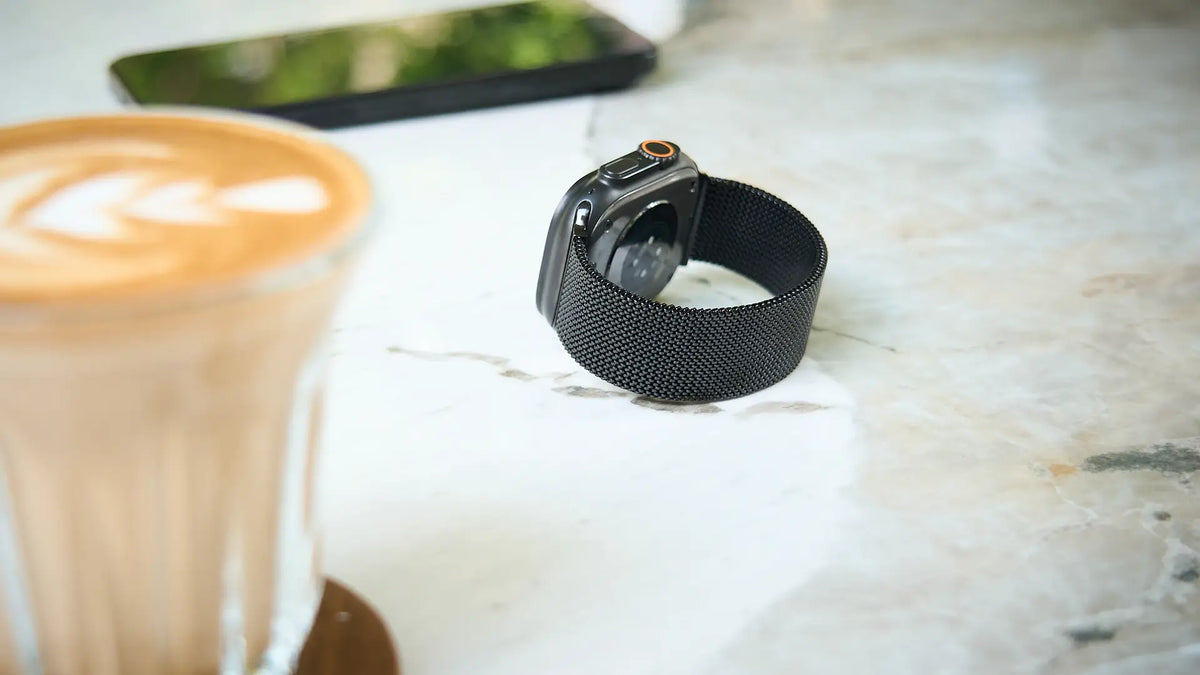
An Apple Watch band with no clasp sounds like a simple idea: remove the hardware and close the band into a loop. But a clasp does real work. It joins two ends, opens the band, and often helps adjust the fit.
So with One Flex, removing the clasp wasn't the end of the design problem. The question was whether the rest of the band could take over those jobs. That is the logic behind the closed woven-metal loop.

What the Clasp Was Doing in the First Place
A clasp isn't useless hardware. On a conventional watch band, it solves a basic problem: two separate ends need a way to come together and stay together on the wrist.
Depending on the band, the closure may also help set the fit. A buckle uses different holes. A sliding clasp can move along the band. Other clasp systems allow some adjustment after the watch is already on your wrist. In each case, the hardware does more than simply close the band.

That matters when designing a no clasp watch band. Taking away the clasp doesn't remove the need for closure or fit. Those jobs still have to happen somewhere.
For One Flex, the design uses one continuous loop instead of two loose ends joined by closure hardware. One Flex is a single loop of woven 316 stainless steel with no clasp, buckle, or pin.
That simpler form creates a harder requirement: a closed metal loop still has to pass over the hand, fit the wrist without on-wrist adjustment, and recover after repeated stretching.
Remove the Clasp, and the Rest of the Band Has to Do More
That's the central design problem behind a clasp-free Apple Watch band. Fewer parts don't mean fewer jobs. The jobs move into the structure that remains.
The Weave Has to Open the Loop
With no clasp to open, the loop itself has to expand.
One Flex does that through its woven metal structure. Fine strands of 316 stainless steel form a flexible mesh, allowing the loop to stretch over the hand instead of relying on a buckle or clasp to create an opening. The stretch comes from the structure of the weave, not from a hidden rubber or fabric element.
For a watch band with no clasp, that's the first requirement: the band itself has to create the temporary opening needed to put it on.
The Size Has to Set the Fit
A traditional adjustable band can be tightened or loosened after it's on the wrist. One Flex can't.
Its fit therefore has to come from the size of the loop itself. One Flex comes in nine loop sizes, numbered 3 through 11, rather than using a clasp for on-wrist adjustment.

That makes sizing part of the construction, not just a purchasing detail. For a no buckle Apple Watch band, the trade is straightforward: remove the adjustment hardware, and the sizing system has to do more work before the band ever reaches the wrist.
The goal isn't to eliminate sizing. It's to move adjustment from hardware you operate during wear to a size you choose in advance.
The Loop Has to Recover
Stretching over the hand solves the problem of getting a closed loop on. Repeated stretching raises another question: what happens when the tension is released?
For a fixed-size clasp-free watch band, recovery matters because the band needs to return close to its resting shape after each stretch. Otherwise, there's no clasp available to take up additional length afterward.
In our factory's internal testing, One Flex recorded 99.6% shape recovery after 50,000 stretch cycles. That result doesn't mean the band can never change shape, and it isn't a lifetime guarantee. It shows that shape recovery was treated as part of the design problem rather than assumed.
What You Gain — and What You Give Up
A no clasp watch band changes the wearing experience in a few specific ways.
There's nothing to fasten each time you put the watch on. No buckle to thread, pin to place, or clasp to close. Once the loop is over the hand, the band is already in its wearing position.

It also removes rigid closure hardware from the band. For someone who spends hours typing, wears fitted sleeves, or simply prefers a continuous band profile, that can be a meaningful difference.
But removing the clasp also removes the adjustment it normally provides.
With One Flex, you can't tighten the band one notch after putting it on or loosen it during the day with a clasp. The selected loop size has to do that job from the start, and the band has to stretch over the hand each time it goes on or comes off.
That means a clasp-free Apple Watch band isn't automatically the better structure for every wearer. If you value a continuous loop, fewer parts to operate, and a fixed fit once the band is on, the no-clasp approach may make sense. If you prefer frequent micro-adjustment on the wrist, an adjustable clasp can still be the more practical option.
See how the clasp-free loop works in One Flex.
See the One Flex →What “One Less” Means Here
“One Less” isn't about removing parts for the sake of minimalism. A simpler product only works if the essential job still gets done.
That's the standard behind One Flex. The clasp is gone, but its functions didn't disappear. They moved into the loop, its sizing, and the structure that lets it stretch and recover. This follows Eclipex's broader design principle: subtraction only works when what remains can still do the necessary work.
That distinction matters when thinking about a no clasp watch band. Fewer components aren't automatically an improvement. Removing one only works if the remaining structure can still do the necessary work.
That's what “One Less” means here: less hardware, without leaving the job undone.
One Less. One Flex.
The Next-Gen Milanese Solo Loop
Shop One FlexShare:
How Can a Metal Watch Band Stretch? Inside the Structure of One Flex