

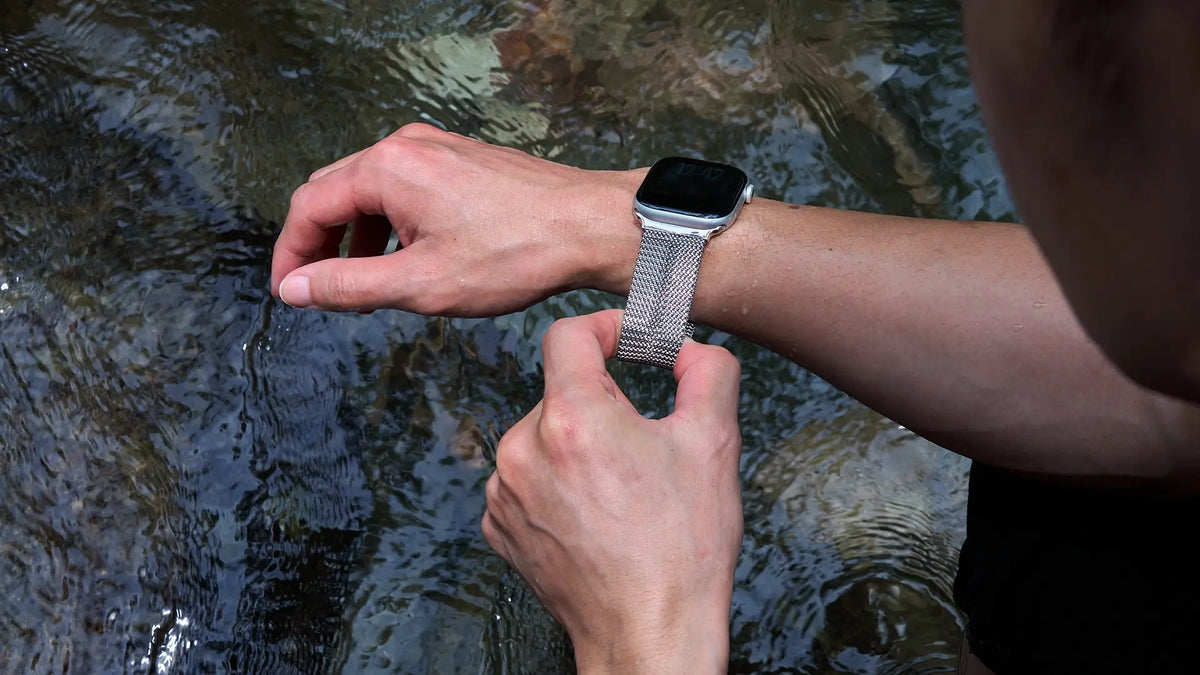
One Flex is a metal watch band, but it does something most people don’t expect from metal: it stretches. The loop can expand over the hand, flex around the wrist, and twist as the wrist moves.
The mechanism is structural. The steel doesn’t need to behave like rubber for the finished band to change shape. The woven structure gives the loop room to move.

How a Metal Watch Band Can Stretch
A stretch watch band can be made from metal because the finished structure can change shape even when the material itself is relatively rigid.
One Flex is made from woven 316 stainless steel. When the band expands, it isn’t relying on the steel to behave like silicone or rubber. The weave changes geometry, allowing the loop as a whole to expand, bend, and twist.
The distinction is simple: the material stays metal, while the structure is able to move.
What Moves Inside the One Flex Weave?
The movement comes from the geometry of the weave.
At Rest: A Woven Metal Structure
At rest, One Flex forms a continuous loop of woven 316 stainless steel. The metal isn’t arranged as a solid strip or a row of rigid bracelet links. It forms a mesh with a resting shape of its own.
That construction leaves room for small changes across the weave while the band still holds its overall loop form.
Under Load: The Weave Changes Geometry
Pull One Flex over the hand and the loop expands.
Under tension, the woven structure changes geometry. Movement is distributed through the mesh, allowing the loop to become larger without a clasp, buckle, or hidden elastic element.
That same structural freedom allows movement in more than one direction. As the wrist bends and rotates, One Flex can flex and twist rather than resist every change in angle like a fixed metal ring.
After Release: The Structure Moves Back
Once the pulling force is reduced, the weave moves back toward its resting geometry.
Expansion helps the loop pass over the hand. Returning toward its resting form lets it settle around the wrist afterward.
Why a Clasp-Free Metal Loop Needs Stretch
Continuous watch bands aren’t new. Apple’s Solo Loop and Braided Solo Loop both form a closed loop around the wrist without a clasp or buckle. The difference is how each one gets enough give to pass over the hand.
Softer Materials Make Stretch More Direct
Apple’s Solo Loop is made from liquid silicone rubber, so the material itself is naturally suited to bending and stretching.
The Braided Solo Loop uses recycled polyester yarn woven around ultrathin silicone threads to create a stretchable slip-on loop.
Those are practical ways to remove a clasp, but they have a different visual and material character from metal. For people who prefer a metal band at a desk, in a meeting, at dinner, or in more formal settings, silicone or braided textile may not give them the look they want.
Some Apple Watch users simply prefer metal.
Doing the Same Job in Metal Changes the Problem
Traditional metal bands usually solve the hand-passage problem by opening at a clasp, buckle, or magnetic closure. A continuous metal loop can’t rely on that step.
Remove the clasp, and the loop itself has to expand enough to pass over the hand, flex and twist as it settles around the wrist, then return toward the dimensions it was sized to hold.
That is the problem One Flex is built around. If the hardware is gone, useful movement has to come from somewhere else in the system. In One Flex, it comes from the woven metal structure.
Why Shape Recovery Matters

Stretch alone isn’t enough.
For a sized continuous loop, the structure also has to move back toward its resting shape after the load is removed. Otherwise, repeated use could leave the loop progressively longer and looser, with no clasp available to tighten it.
That’s why flexibility and shape recovery are different questions. One asks whether the band can move. The other asks whether it can return toward the dimensions that make the loop wearable.
Eclipex reports 99.6% shape recovery after 50,000 stretch cycles for One Flex. The percentage matters together with the cycle count: it describes how closely the structure returned toward its original shape after repeated stretching. It does not mean the band can never deform or that its fit will remain unchanged under every possible condition.
A single stretch demonstration shows that the band can move. Repeated cycling asks the more useful question: can it keep returning toward its resting form?
How Different Metal Bands Create Stretch
The term “stretch watch band” describes what a band can do, not one specific construction.
| Structure | Where the movement comes from |
|---|---|
| Common spring-loaded expansion bracelet | Spring-loaded link movement between metal components |
| One Flex | Movement distributed through a woven metal structure |
| Flex Link | Link-integrated spring movement built into the metal links |
Many traditional expansion bracelets create give through repeating spring-loaded link mechanisms. Historical expansion-band designs, for example, use springs and connecting members inside linked metal sections to create an expansible bracelet.
Flex Link takes a different all-metal approach. Its polished alloy links flex against one another through link-integrated spring movement, while an adjustable clasp remains part of the band. There is no rubber, elastic thread, or elastic core providing the stretch.
One Flex distributes movement through the woven structure instead. There is no row of separate expansion links doing the work.
The result may look similar from the outside—a metal band that gives instead of staying rigid—but “stretch” alone doesn’t tell you how that movement is created.
What Structural Stretch Means on the Wrist
Once the band is on, structural stretch still matters because the wrist doesn’t stay in one fixed position.
It Lets the Band Follow Wrist Movement
Typing, lifting, reaching, rotating the hand, or simply bending the wrist changes the angle and shape the band has to follow.
One Flex can respond because its woven structure can flex and twist with those changes. Instead of forcing the wrist to move inside a fixed metal shape, the loop has some ability to move with it.
It Helps the Band Conform More Closely
A wrist isn’t a perfect circle, and its shape shifts slightly as the hand moves. Because the woven loop can bend, flex, and twist, it can follow those contours more readily than a completely rigid structure.With the correct size, that gives the band room to sit close to the wrist without depending on a clasp adjustment every time the wrist changes position.
Structural stretch doesn’t replace sizing. The resting circumference still matters. What it changes is how much the band can adapt around that starting fit.

It Can Make the Fit Feel Less Rigid
Comfort isn’t only about softness.
A metal band can feel restrictive when its structure resists small changes in wrist position. A band that can flex, expand, and twist has more ways to accommodate those movements instead of opposing them like a fixed ring.
For the wearer, that can mean a fit that feels less rigid and more accommodating as the wrist bends and rotates. Structural stretch doesn’t mean unlimited expansion or make sizing irrelevant; it means movement is built into the metal structure itself, allowing a continuous woven loop to stay metal while adapting more readily to the wrist.
That is One Less in practice: keep the metal, remove the clasp, and let the woven structure do the work.
One Less. One Flex.
The Next-Gen Milanese Solo Loop
Shop One FlexShare:
Why We Removed the Clasp From One Flex