

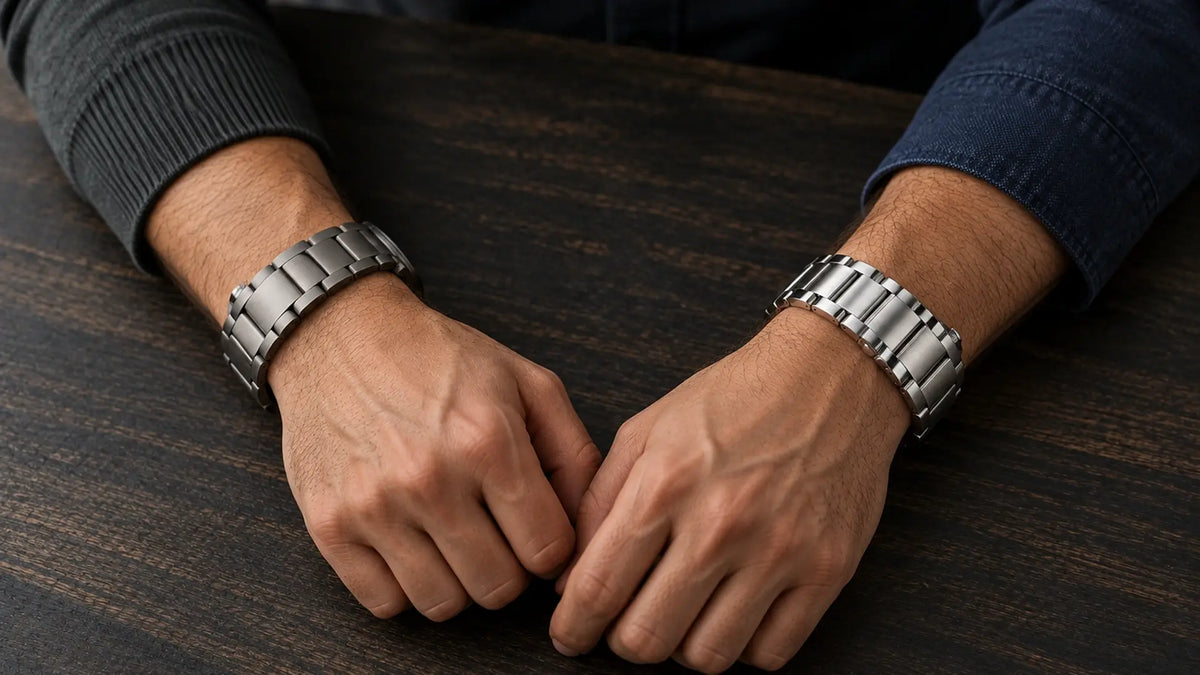
- Titanium vs Stainless Steel Apple Watch Bands at a Glance
- Weight: Why Lower Density Does Not Mean a Fixed Band-Weight Difference
- Feel on the Wrist: Construction and Closure Matter Too
- Cost: What Are You Actually Paying More For?
- Scratches, Finish, and Corrosion: The Metal Name Is Not Enough
- Which Material Makes More Sense for Your Apple Watch Band?
If you're choosing between a titanium and stainless steel Apple Watch band, titanium's lower density gives it more potential to cut weight. But the material alone doesn't tell you which band will feel better—or which offers better value.
The useful comparison is the finished band: how much it weighs, how it's built, how it closes and fits, what finish it uses, and what it costs.
Titanium vs Stainless Steel Apple Watch Bands at a Glance
Titanium is substantially less dense than 316/316L stainless steel, which gives it a real advantage when reducing mass is the goal. But a material label still doesn't tell you how a finished band will behave on your wrist.a
| Factor | Titanium | Stainless Steel | What You Still Need to Check |
|---|---|---|---|
| Material density | Lower | Higher | Finished band weight |
| Wrist feel | Can reduce overall mass | Can feel more substantial | Thickness, flexibility, and weight distribution |
| Construction | Can be mesh or links | Can be mesh, links, or other structures | How the band actually moves and closes |
| Surface wear | Depends on grade and treatment | Depends on alloy and finish | Coating, polishing, and surface treatment |
Start with the material, but make the decision based on the finished band. For an actual titanium vs stainless steel watch band comparison, the next number to look for is the weight of the band you're considering.
Weight: Why Lower Density Does Not Mean a Fixed Band-Weight Difference
ATI lists Grade 2 titanium at 4.51 g/cm³, while Alleima lists 316/316L stainless steel at 8.0 g/cm³. On an equal-volume basis, that makes Grade 2 titanium about 44% less dense. That's a meaningful material difference, but a finished watch band isn't an equal-volume sample.

Final weight also depends on how much material the band uses. Width, thickness, link geometry, mesh density, clasp size, connectors, and total length can all change the result. Two bands made from different metals can end up closer in weight than their raw density figures suggest.
That's why a raw-material percentage shouldn't be treated as a promised weight saving for a finished band. When comparing bands you might actually buy, look for the manufacturer's finished band weight. If a listing gives you only the material name, you can tell which metal is less dense. You can't tell how many grams the finished band will save.
Feel on the Wrist: Construction and Closure Matter Too
Once you move from raw material to an actual Apple Watch band, total weight is only part of how the band feels. The same metal can behave very differently depending on whether it's woven into mesh, formed into rigid links, or paired with a particular closure.
For day-to-day wear, the main variables are:
- Flexibility: Fine mesh can drape around the wrist, while rigid links move in sections.
- Weight distribution: Two bands with similar total weight can feel different if more of that mass sits in the clasp or under the wrist.
- Thickness: A thicker band can feel more substantial even when the material itself is relatively light.
- Closure and fit: Magnets, clasps, buckles, and loops change how the band adjusts, where the hardware sits, and how steadily the watch stays in place.
Apple's Two Milanese Loops Show Why Material Is Only One Variable
Apple's current stainless steel Milanese Loop uses woven steel mesh with a fully magnetic overlapping closure and a PVD finish. The Titanium Milanese Loop uses aerospace-grade titanium mesh with a parachute-style buckle and is designed for Apple Watch Ultra.

| Feature | Apple Milanese Loop | Apple Titanium Milanese Loop |
|---|---|---|
| Material | Stainless steel mesh | Titanium mesh |
| Closure | Magnetic overlap | Parachute-style buckle |
| Adjustment | Magnetic sliding fit | Buckled fit |
| Product focus | Works with most Apple Watch versions | Designed for Apple Watch Ultra |
These aren't two otherwise identical bands with only the metal swapped. The closure and adjustment system change too. If one feels lighter, less bulky, more secure, or simply different on the wrist, the material may be part of the reason, but it can't explain the entire experience.
Cost: What Are You Actually Paying More For?
Titanium Apple Watch bands can cost more, but the price difference between finished products can't automatically be assigned to the metal.
As of September 27, 2026, Apple lists its stainless steel Milanese Loop at $99 and its Titanium Milanese Loop at $199. Eclipex lists One Flex at $59.99.
| Band | Material / Construction | Closure | Current Price |
|---|---|---|---|
| Apple Milanese Loop | Stainless steel mesh | Magnetic overlap | $99 |
| Apple Titanium Milanese Loop | Titanium mesh | Parachute-style buckle | $199 |
| One Flex | Woven 316 stainless steel, continuous stretch loop | None | $59.99 |
These aren't three versions of the same band. Apple's two Milanese models change both the material and the closure. One Flex takes another approach: woven 316 stainless steel in a continuous stretch loop with no clasp, buckle, pin, or magnet.

That's what makes the price comparison useful. Material is only one part of what you're paying for. Construction, closure, surface treatment, sizing system, manufacturing, and brand positioning can all affect the final price.
A better question than "How much more does titanium cost?" is "What does this specific band give me for the extra money?"
That question is easier to answer when the manufacturer also provides useful finished-product information, such as weight, material specification, construction, and closure.
A lower price doesn't prove better value either. One Flex costs less than both Apple examples, but it isn't a direct equivalent; it handles fit and closure differently. Price becomes useful only after you've compared the products on the features that matter to you.
Scratches, Finish, and Corrosion: The Metal Name Is Not Enough
Scratch resistance is difficult to reduce to a simple titanium-versus-stainless rule because visible wear depends on more than the base metal.
Titanium Grade Changes the Comparison
Not all titanium used in watch bands is the same material. ATI's Grade 2 titanium is commercially pure titanium, while Grade 5 titanium is Ti-6Al-4V, an alloy containing aluminum and vanadium with different mechanical specifications. A listing that says only "titanium" therefore leaves out information that may matter when you're comparing finished products.
That also limits what you can infer from Apple's Titanium Milanese Loop. Apple describes it as aerospace-grade titanium mesh and lists the material as 95% recycled titanium, but the current product page doesn't identify a numbered titanium grade. Calling it Grade 2, Grade 5, or anything else would go beyond Apple's published specification.
Finish and Surface Treatment Affect Visible Wear
The surface you see may not be bare base metal. Apple's stainless steel Milanese Loop uses an additional PVD layer for its finish.

So a useful scratch comparison needs more than titanium vs stainless steel. It needs the material grade, surface treatment, and finish. Without those details, a blanket claim that one metal will simply scratch less is too broad for a finished watch band.
Corrosion Is a Material Advantage, Not a No-Care Promise
ATI documents commercially pure titanium for corrosive environments, including seawater, while material data for a 316 stainless steel Apple Watch band shows that molybdenum improves resistance to pitting and crevice corrosion compared with 304/304L stainless steels.
Those are material-level properties, not guarantees for every finished band. A band may also include connectors, clasps, coatings, welds, or other components with different materials and care requirements.
For buyers, the practical step is to check what the complete band is made from and follow the care and water-use guidance for that specific product rather than treating either metal as maintenance-free.
Which Material Makes More Sense for Your Apple Watch Band?
The choice comes down to what you want the finished band to change.

Prioritize Titanium When Lower Mass Is the Main Goal
Titanium deserves closer attention when reducing weight is one of your main reasons for changing bands.
Look for a titanium option when:
- you notice the weight of a metal band during long wear,
- the manufacturer publishes the finished band weight,
- the material or grade is clearly identified,
- the closure and sizing system suit you,
- and the price difference makes sense for the specific product.
Titanium's lower density creates the opportunity to reduce mass. The finished weight tells you whether a particular band actually does.
Prioritize Stainless Steel When Construction or Value Matters More
Stainless steel can make more sense when your priorities are tied more closely to the design of the band than to minimizing every gram.
That may be the case if:
- you prefer a more substantial metal feel,
- the stainless option uses the mesh, link structure, or closure you want,
- the titanium alternative doesn't provide enough finished-product information to justify its price,
- or the stainless band gives you the fit and adjustment method you prefer at a lower cost.
Check the Finished Band Before You Decide
Before choosing either material, compare the actual products using our metal Apple Watch bands buying guide checklist:
- What is the exact material or grade?
- What does the finished band weigh?
- How is the band constructed, and how does it close?
- Is there a coating or surface treatment?
- How does the sizing system work?
- What is the current price?
If lower mass is the priority, titanium gives you a meaningful material advantage to investigate. If construction, closure, fit, or price matters more, stainless steel may give you the combination you want.
The useful question isn't which metal wins in general. It's whether the finished band turns that material difference into something you'll actually notice.
One Less. One Flex.
The Next-Gen Milanese Solo Loop
Shop One FlexShare:
One Flex Size Guide: How to Find Your Band Size
Apple Watch Band Sizes for Small Wrists: A Fit Guide